How CD & MD Monitoring Reduces Energy Costs
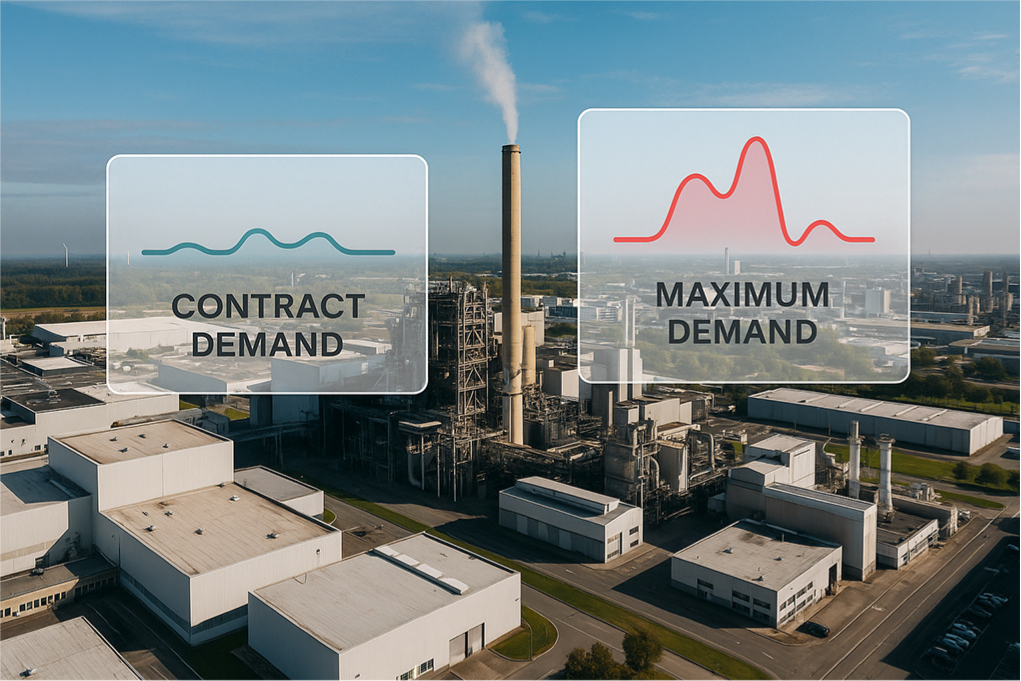
Introduction
In today’s high-consumption industrial environments, Contract Demand monitoring, Maximum Demand monitoring, and energy cost optimisation have become critical for manufacturing units. Many plants unknowingly lose lakhs every year due to incorrect CD settings, MD spikes, and a lack of real-time monitoring.
What Is Contract Demand and Maximum Demand?
Contract Demand (CD):
Contract Demand is the maximum load (in kVA) that a manufacturing unit agrees to draw from the utility provider.
You pay fixed monthly charges based on this number—regardless of your actual usage.
Example:
If your CD is 1000 kVA, you pay for 1000 kVA every month, even if you use only 600 kVA.
Maximum Demand (MD):
Maximum Demand is the highest load (in kVA) that your plant actually draws during any 15- or 30-minute period within a billing month.
The utility uses MD to determine:
Whether you have exceeded your CD (penalty zone)
Whether your CD is oversized and costing you extra
The Root Cause of Rising Energy Costs in Plants
Manufacturing units face two major billing losses due to poor visibility into CD–MD behaviour:
Exceeding Contracted Capacity: Impact on Your Energy Costs
If the plant’s Maximum Demand (MD) rises above the contracted limit (CD)—even for a single 15- or 30-minute interval—the utility applies additional charges. These typically include:
Elevated demand tariffs or penalty multipliers
Excess load or overdraw charges
Higher monthly billing due to non-compliance with contracted limits
Such exceedances generally occur during operational load surges, including:
- Simultaneous startup of large motors or compressors
- High inrush currents during equipment activation
- Peak production periods
- Shift transitions where multiple loads come online together
This creates unpredictable and avoidable cost spikes within the monthly electricity bill.
When Maximum Demand Remains Below Contract Demand
In many facilities, the contracted capacity is significantly higher than the actual requirement. When MD consistently remains below CD, the plant continues to pay fixed charges on the entire contracted kVA, regardless of usage.
This results in:
- Recurring fixed costs for unutilized capacity
- Reduced cost efficiency across operations
- Accumulated annual losses that often go unnoticed
Example:
Contract Demand: 1000 kVA
Actual Maximum Demand: 600 kVA
The plant still pays for the full 1000 kVA
The unused 400 kVA represents a continuous financial drain, driven solely by an oversized Contract Demand.
Oversized CD Creates Constant Financial Leakage
Manufacturers often oversize CD for “future expansion,” but this unused capacity costs lakhs annually in avoidable fixed charges.
How StatStream Improves Contract and Maximum Demand Control
StatStream delivers a complete Contract Demand Monitoring and Maximum Demand Control solution using an industrial IoT gateway and cloud analytics.
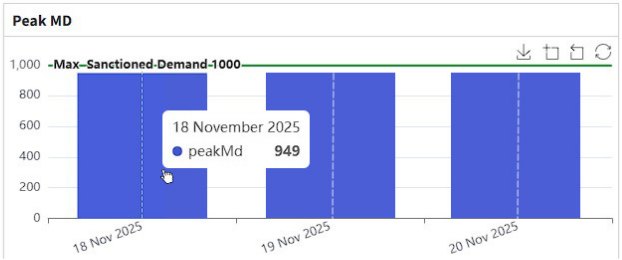
Reducing Avoidable Costs with Real-Time Insights
1. Prevent Penalties (MD > CD)
StatStream provides:
- Real-time load tracking
- Alerts at 85%, 90%, and 95% of CD
- Early warnings before MD crosses CD
- Support for automated load shedding
2. Reduce Fixed Charges (MD < CD)
StatStream identifies:
- Monthly MD trends
- Unused kVA
- Correct the CD based on real consumption
- Safe recommendations to reduce CD
Both are preventable.
StatStream gives plants complete visibility into Contract Demand and Maximum Demand, helping them reduce unnecessary charges, prevent penalties, and save excess costs every year.
Conclusion
StatStream provides the tools to detect penalties before they happen and to right-size contracted capacity based on real usage. With real-time alerts, monthly trend insights, and safe CD-reduction recommendations, manufacturing units can stop financial leakage, stabilise quarterly energy costs, and save lakhs each year.